Tuesday, April 30, 2013

Preparing for 2013 fawns!

It will soon be that time of the year again!
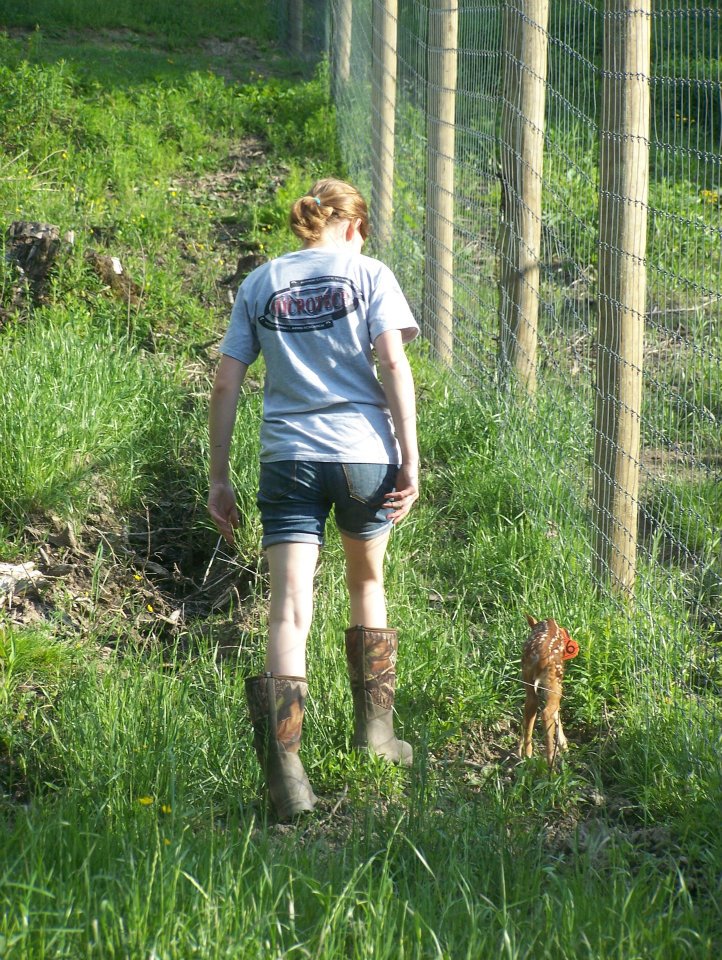
    Fawn season! The farm will be preparing for the fawns arrival next month. A doe's gestation period is about 200 days and we predict that we will have our first fawns on the ground on May 21st. Of course the gestation period may be altered depending on how many fawns the doe is carrying and the does environment etc. Fawn Season is a bit like Christmas and Easter together. The doe will start pacing non-stop around the fence 12-24 hours before she has the baby. Last year all of the fawns were born at night so we would all wake up in the morning knowing that there was a fawn hiding somewhere in the pasture. A whole lot like an Easter egg hunt! Fawns are about 3/4 the size of a dinner plate when curled up so they are difficult to find. Once they are located we ID them with a plastic ear tag and a microchip. The PA Dep. of Agriculture requires for captive whitetails to have two forms of ID with at least one visible. The fawn receives some probiotic paste orally, 2cc of vitamin B complex under the skin (SQ), and some iodine on it's belly button. We tag all of our doe fawns in their left ear and all of the buck in their right ear, this way we can tell their gender at a glance.
One of our 2012 fawns hidden in the golden rod
    After they have their ID's it is all logged in the herd inventory sheet the babies are put back with their mothers. The doe fawns are pulled off of the mother after 6-12 hours. We then take the female fawns and bottle feed them, this makes them easier to handle as they grow up. The buck fawns are rarely bottle fed because when they grow their antlers they become dangerous, especially during the rut (mating season). We never pull the doe fawns form the mother before they are 6 hours old because the mother doe needs time to pass the colostrum through to her fawn. The colostrum is crucial to the fawns survival. I could go on for a long time but I will write more on bottle feeding in a couple weeks.

    Here is a video of a fawn being born! This was not on our farm, but it's still really cool!


P.S. The bucks have also started to grow antlers! This picture of Mr. is from last week, since then he has put on a about 2" more growth!


Friday, March 15, 2013

"Chipped" Hooves

About a week ago we had a thaw in the winter weather and then it re-froze, forming a hard crust. One of the other doe chases Deedee around a lot and we came to the conclusion that her hoof pads were damaged by running through the icy crust. I sprayed Blue-Kote on it the left chipped hoof and noticed that her right front leg also had a chip but there was a flap of pad covering it. I figured the flap might protect it some so I didn't mess with it.
I checked it this morning and the flap has grown longer, all of the way up to the hair. The left hoof I don't think is getting infected but it has mud in it so I can't tell for sure. Deedee gets irritated when I touch it though.


 I checked with the guys over on the whitetail farming forums and one of them recommended Kopertox which is actually for treating thrush in horse hooves. It's also a waterproof bandage which will help very much in the yucky slush/mud weather. I hope that they have some at Tractor Supply!

Part of her treatment is getting extra peanuts and hugs as prescribed by "Dr." Autumn!


Also Deedee is now use to coming into the barn now, she use to hate buildings with an avid passion.

Thursday, February 21, 2013

New Doe/Penn State Seminar/ Webinars

   On January 25th we got a phone call from our buddies that I bought Lilly from. They felt that they needed to "make it right" and wanted to give me one of their doe who was pregnant. I was pretty surprised, I wasn't suspecting that! The doe's name is DeeDee, she is six years old and very docile. I 'met' her before when we went down to their farm to help with the spring fawns. We picked her up on February 9th! DeeDee does NOT like to go into or be in buildings, so that is one thing I will have to work on with her. She was bred with an up and coming yearling buck that was sold, he'll be marketed as "XL's Maxin" so keep a lookout! I'm praying for buck fawns from her, I need to make some money back. DeeDee is settling in alright but she is so timid of the other doe. #99 chases her because DeeDee lets her.
     Last Sunday we separated Mr. Bob from the adult doe and put him with the buck fawns. Then we put the doe fawns in with the adult doe. Beatrix was on the top of the totem pole when she was with the doe fawns, but now that she is with the mama doe she is on the bottom. She doesn't like that, but she'll have to get use to it!

    On March 23rd we'll be taking a road trip down to State College, this time it will be to attend the Nutrition and Feeding Management for Deer Farms.  It's from 8am to 4pm and they will serve a meal. I can't wait to go, it will be one long day but it will be worth it! The topics will include
  • Ruminant anatomy and feeding behaviors
  • General feeding practices
  • Life cycle nutrition (Fawns, pregnant does,
    adult bucks, etc.)
  • Pen soil, forage, and water analysis
  • Regulatory update (CWD, TB, etc.)
    Dad and I will be going along with our neighbor Pete and hopefully our veterinarian, Dr. Tanner, who is being trained to take care of whitetails. I'm not looking forward to getting up early so we can leave at 5:30am though. It takes roughly 2 1/2 hours to get from point A to point B going the speed limit. 
     For those who don't know, Penn State has a program dedicated to researching whitetails and whitetail farming. Recently I had been poking around through their website and found a mini-series webinar about whitetail deer management. It's from 2011 and it is directed at managing deer in the wild but it is highly informative and I would recommend anyone who wants to learn more about the species. I watched the one on whitetail breeding biology and communication. Click to be taken to their site -> Whitetail deer management series
   

Friday, January 18, 2013

Death of a good doe and a warning against shadecloth.

   Our five year old doe Lilly (Purple #809) died Tuesday night after a long struggle. After an autopsy we discovered that two softball sized wads of shade cloth had shifted and plugged her intestine off, half starving her. Shade cloth is a cloth barrier that farmers use to create shade for their animals, hence the name. We do not use shade cloth, on our farm so it was in her stomach ever since we purchased her from another whitetail farm a year ago. They've also been having problems with other deer eating shade cloth and dying from not being able to pass it and took it all the cloth down.
  
   Now it makes sense why 809 never gained weight properly and that she only had one small fawn this spring when in the past she always had twins. Her body just couldn't process food properly. No matter how much medicine we gave her it wouldn't have helped.
  
   Sarah Yurisic from The Pennsylvania Department of Agriculture came and took a brain stem sample to test for Chronic Wasting Disease, which is mandatory for all whitetail deaths. She also extracted the lymph nodes, and piece of ear, and 809's identification tag. Why the extras? If the brain stem proves untestable the lymph nodes may be tested also. The piece of ear and farm tag is for DNA.
    
   It's all part of farming.